

Printing technology
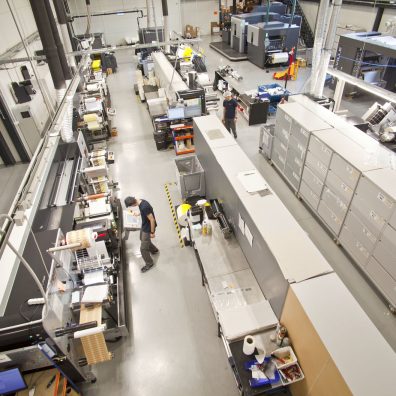
Printing technologies could be roughly divided into digital and classic. Although there is a wide range of possible options within these two categories, we will limit ourselves only to laser or inject toner technology (digital) and flexography (classic) as the most commonly used technologies. Each has its own specifics and therefore it is good to be aware of a few basics. In both technologies, printing is carried out from roll to roll, hence the labels are also wound on the roll.
There are certain technical limitations to each technology, and it is often necessary to combine several technologies in order to achieve optimal results. LabelProfi offers the best of both worlds.
Flexography
In the case of flexography, the image is printed on the surface from colour-coated printing plates (clichés). Flexography works effectively on a variety of absorbent and non-absorbent materials, including metals, cellophane, paper and plastics.
Because flexography works at a higher speed than digital printing, it is an effective solution for producing medium to large batches with quality results. Due to the production of clichés, flexography has a very high initial cost and requires longer preparation of printing machines, compared to digital printing.
We use digital printing when the following is required:
- flexibility of manufacture (frequent design changes)
- highest print quality
- personalization
- variable data printing
- fast response – short delivery times
- small to medium series and numerous different finishes
- production of sample batches for subsequent large-scale production
- effective ecological and sustainable solutions
Gravure printing
Gravure printing is the process during which a desired image is engraved into a copper cylinder intended for printing. The press cylinder is coated with colour and then pressed onto the medium. This technological process is particularly cost-efficient and rational, especially in the production of large volumes such as magazines, newspapers, brochures, packaging and other products.
We use flexography when the following is required:
- large quantity of one product type
- printing with special colours (PANTONE scale)